
Two Parking Codes for One Corner?
In land use, there are rules.
There are processes.
There are standards.
And when applicants follow those standards, the expectation is simple:
The process works.
In this case, it did — until it reached City Council.
Step One: The Application
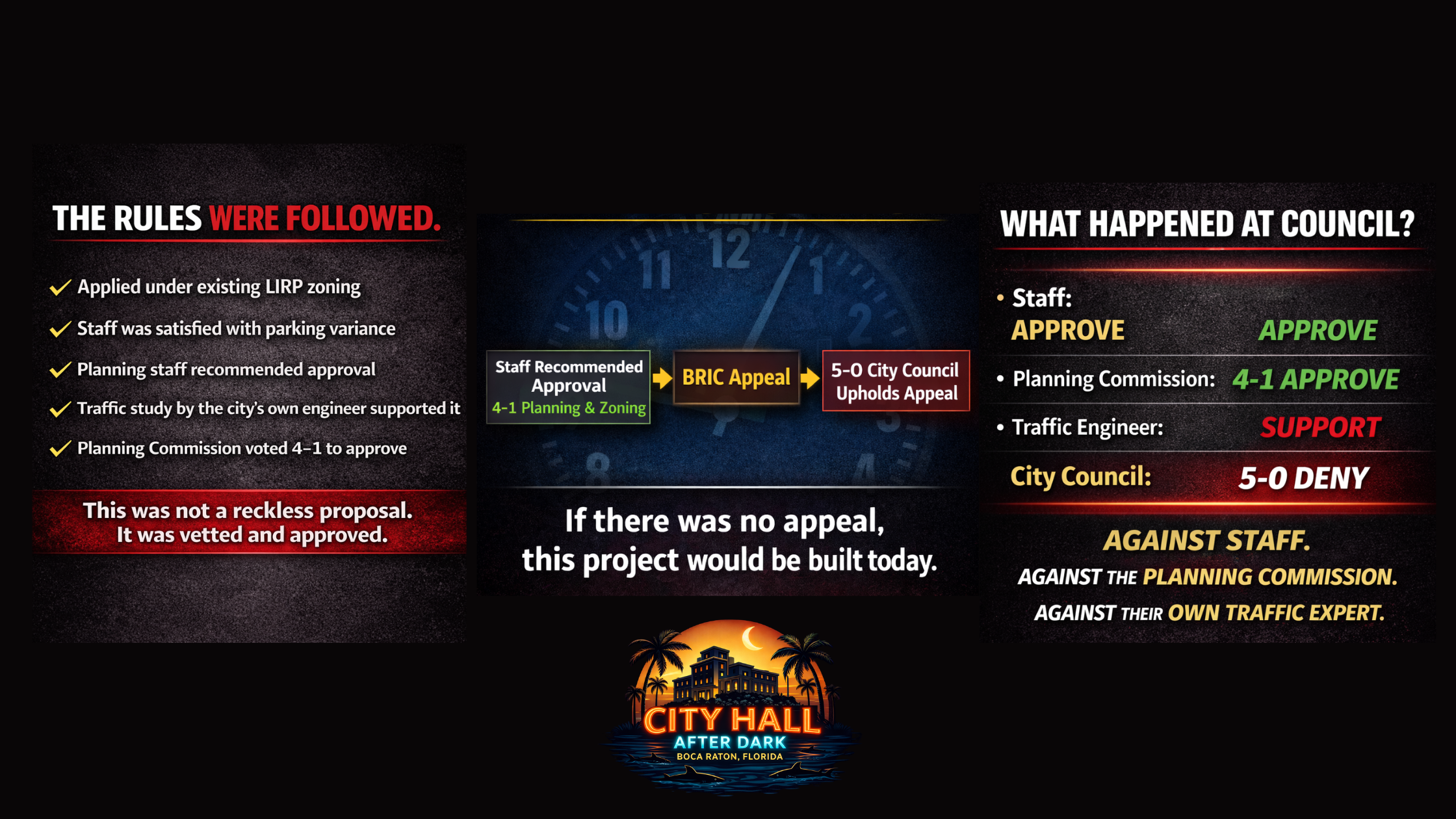
The project was submitted under existing LIRP zoning.
It did not require a conditional use.
It required a parking variance.
Planning staff reviewed the request in full.
The traffic study — conducted by the same engineering firm the City regularly relies upon — supported the variance.
City staff approved the application, supported the request, and formally recommended approval to the Planning & Zoning Board.
The Planning & Zoning Board then voted 4–1 to approve the variance.
By every professional metric presented, the request met the required standards.
The process worked exactly as it was designed to work.
Step Two: The Appeal
In the final days of the appeal period, the neighboring BRiC campus filed an appeal.
That appeal automatically advanced the matter to City Council.
Had the appeal not been filed, the Planning & Zoning Board’s approval would have stood.
Step Three: The Council Vote
At City Council:
Staff maintained their recommendation of approval.
The Planning & Zoning Board’s 4–1 vote remained on record.
The city’s traffic engineer’s findings were unchanged.
The result?
A 5–0 denial.
The stated reasoning: parking.
Against staff.
Against the Planning & Zoning Board majority.
Against the city’s own traffic engineering analysis.
The Irony
Here is where the question becomes larger than one project.
The BRiC campus’s own master plan renderings — including materials presented publicly — show a multi-story building on this same corner.
Under the proposed BRiC rezoning framework, that site would fall under a different parking standard — one with significantly lower requirements than what currently applies.
In other words:
If this same corner were owned by BRiC and incorporated into their new zoning district, it could qualify under a reduced parking code.
But under its current ownership and zoning classification, it was denied for not meeting a stricter one — even though professional staff supported the variance and recommended approval.
That raises a simple question:
Are there two parking standards for the same piece of property?
One for today.
One for tomorrow.
Depending on who owns it?
The Real Question
Zoning decisions must be consistent.
Parking standards must be applied evenly.
Professional recommendations should carry weight.
When staff approves a variance, supports it, and recommends approval to Planning & Zoning…
When Planning & Zoning votes 4–1 in favor…
When the city’s own traffic engineer confirms the parking works…
A reversal deserves clarity.
This is not about special treatment.
It is about equal treatment.
The public deserves to understand:
Why is a multi-story building acceptable on this corner under one zoning framework — but a smaller project is denied under another?
If parking was sufficient under expert review, what changed?
Or did ownership change the outcome?
Why This Matters
Predictability in zoning protects everyone:
Residents
Property owners
Businesses
The City itself
When staff-supported projects that meet professional standards are overturned without new technical findings, confidence in the process erodes.
And that is something no city can afford.