
Follow the Timeline, Follow the Records, Ask the Questions
In Boca Raton, zoning decisions don’t happen in isolation. Votes, ordinance changes, and campaign fundraising often move on parallel tracks. When those tracks intersect — particularly around healthcare and public safety — residents deserve clarity.
This is not an accusation.
This is a timeline.
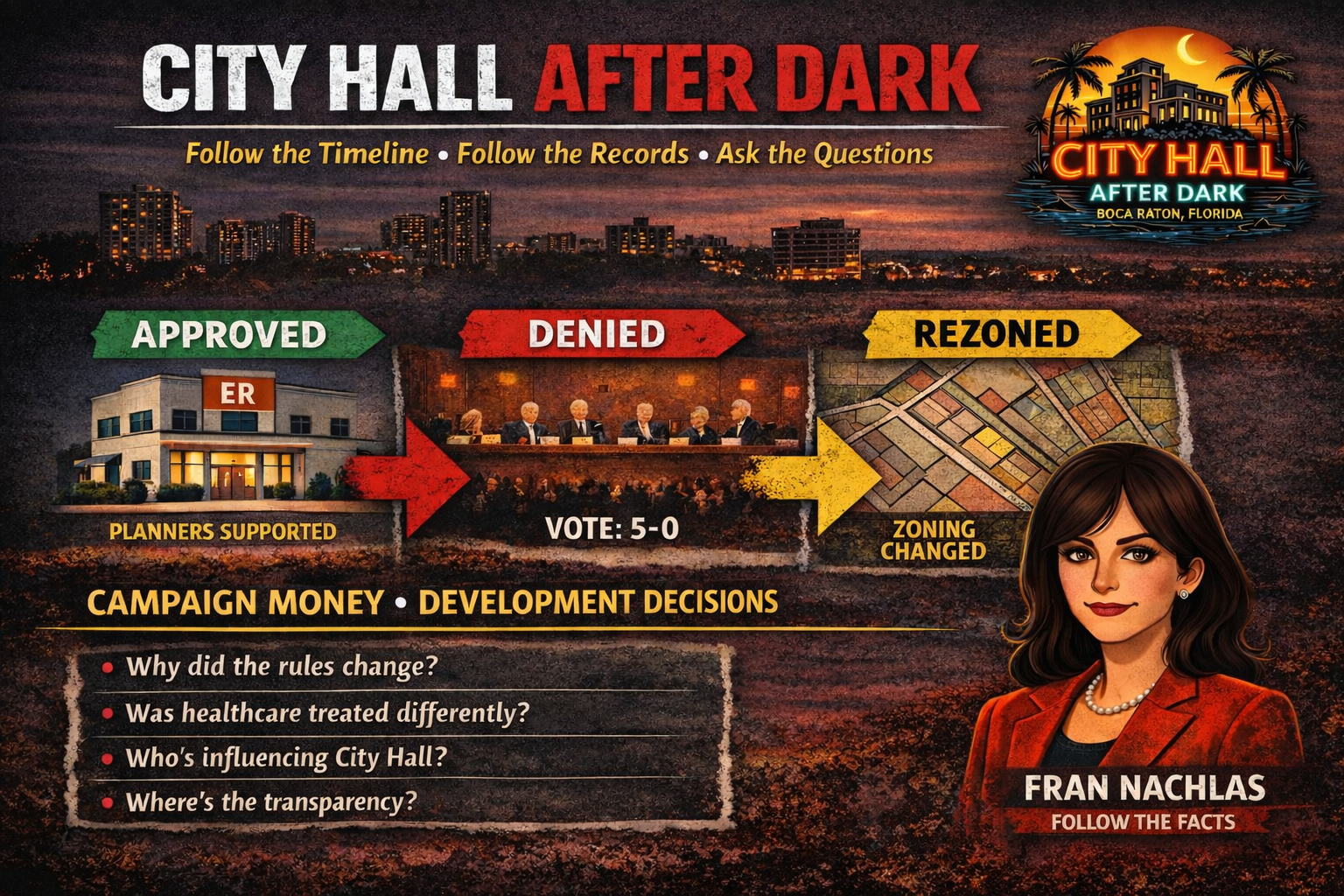
A project approved by planners, denied by council, then blocked by new rules.
The ER That Fit — Until It Didn’t
A freestanding emergency room was proposed for the LIRP corridor, an area experiencing rapid residential growth and limited nearby emergency care access. According to public reporting, city planning staff initially indicated the use was permitted under existing zoning.
Then came the reversal.
The Boca Raton City Council voted 5–0 to deny the project. Shortly afterward, the city moved forward with a zoning ordinance that redefined where freestanding emergency rooms could be located — adding new requirements that effectively excluded the previously proposed site.
Deputy Mayor Fran Nachlas voted with the council majority in opposing the project and supported the subsequent zoning changes as part of the city’s legislative process.
City officials have said the decision was based on land-use compatibility, traffic, and planning policy. Critics point to the sequence — initial support, unanimous denial, then rule changes — as raising reasonable questions about consistency and timing.
City Hall After Dark doesn’t assign motive.
We follow the record.
Campaign Fundraising: What Public Reporting Shows
Fran Nachlas is also a declared candidate for Mayor of Boca Raton. Her campaign fundraising has been covered by multiple local outlets using publicly available campaign finance filings.
Those reports show:
Significant funds raised through political committees in addition to direct campaign contributions
Donations from individuals and entities connected to real estate, land-use, and development professions
Use of political committees, which are legal and not subject to the same limits as individual contributions
All of this is lawful.
All of it is public record.
But in a city where land-use decisions directly affect donors, developers, and residents alike, those records are part of the public conversation — not off-limits.
Why Residents Are Asking Questions
The freestanding ER developer operates within the same local development ecosystem as many firms that routinely interact with city government.
Boca Raton regularly approves and denies projects involving developers, attorneys, and investors — many of whom also participate in civic life as donors.
So when:
A healthcare project is initially deemed permissible
It is later unanimously rejected
Zoning rules are adjusted after the denial
And elected officials involved in the decision are actively fundraising
…it is reasonable — not reckless — for residents to ask:
Why did the rules change after this proposal?
Why were additional requirements applied to this healthcare use?
Were alternative solutions or sites meaningfully considered?
How does City Hall ensure a clear firewall between fundraising and land-use decisions?
These are governance questions. Not personal attacks.
Transparency Is the Issue — Not Motive
City Hall After Dark is not alleging illegality.
We are not claiming quid pro quo.
We are not asserting intent.
We are saying this:
When decisions affect emergency care access, public trust depends on transparency, consistency, and clear explanations.
If the decision was solely about planning policy, the public deserves:
A clear rationale
Consistent standards across projects
Open discussion — not silence or dismissal
Avoiding questions doesn’t resolve them. It amplifies them.
The Bottom Line
Residents shouldn’t have to speculate.
They should be able to understand.
Leadership isn’t just voting —
it’s explaining decisions that affect public safety.
And in Boca Raton, those questions aren’t going away.
City Hall After Dark will keep asking — calmly, clearly, and with receipts.
Disclaimer: This article is based on publicly available records and reporting. It reflects civic commentary and analysis, not allegations of wrongdoing. Readers are encouraged to review source materials and draw their own conclusions.