
When Governance Starts to Look Like Game Strategy
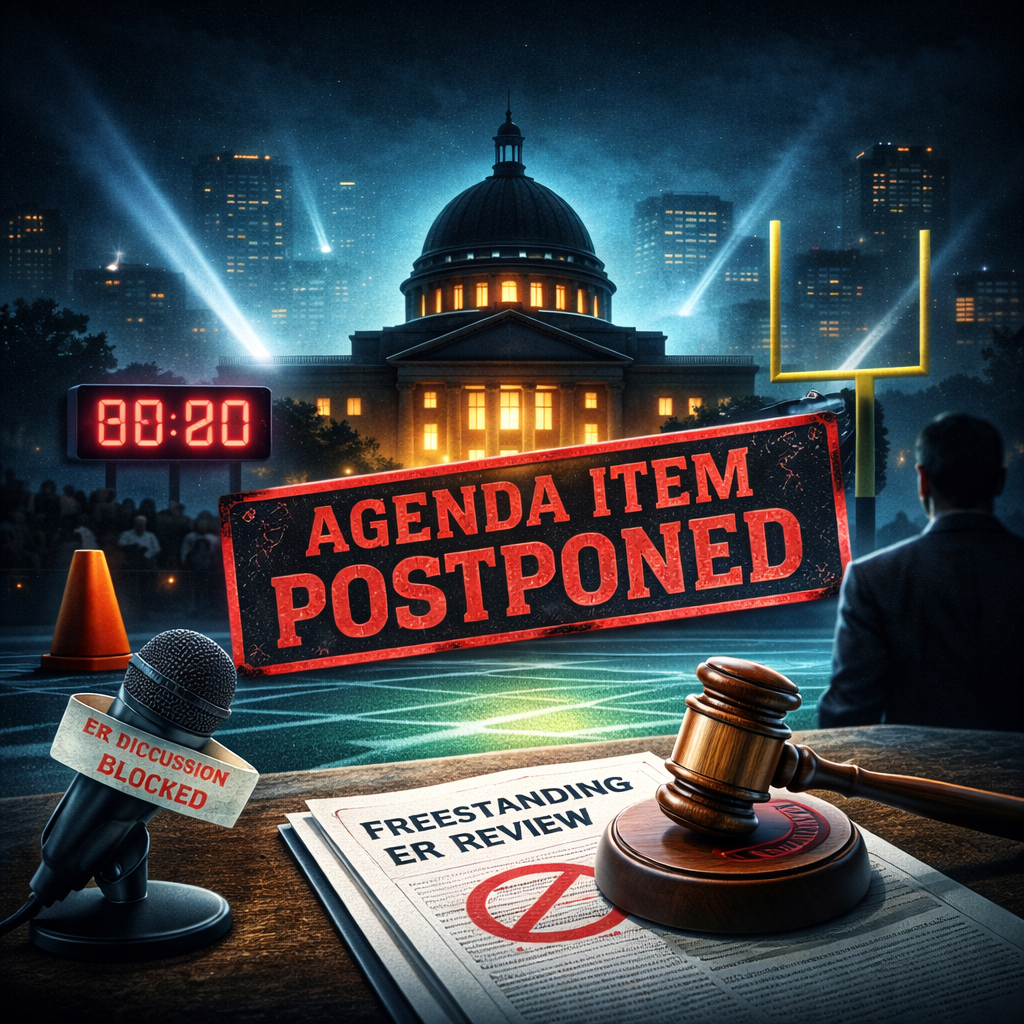
In the days after the Super Bowl, the language of football is everywhere — punts, clock management, field position, delay-of-game penalties. It’s easy shorthand for strategy under pressure. But when those same metaphors start to feel applicable to local government, it’s worth slowing down and asking why.
According to reporting by CBS 12 News, Boca Raton’s scheduled review of the proposed freestanding emergency room was unexpectedly delayed. The item — one that had drawn significant public attention and a room full of residents prepared to speak — was effectively punted down the field. That word matters.
The Politics of the Punt
In football, a punt is not surrender. It’s a strategic retreat.
You don’t advance the ball — but you avoid risk. You reset field position. You buy time. You shift pressure to the other side.
It’s often the safest play when you don’t like the odds of the current down.
Applied to governance, a postponed agenda item can function the same way. No vote. No debate. No answers. Just time.
Time for what?
Time to recalibrate messaging?
Time to regroup privately?
Time to let public momentum dissipate?
When a room is filled with residents ready to ask direct questions about a previously approved project that was later reversed, postponement doesn’t feel neutral. It feels tactical.
Delay of Game — Without the Penalty
In football, a delay-of-game penalty is called when a team runs out the clock without snapping the ball. The rule exists for a reason: the game requires movement. It requires forward motion.
Public process works the same way.
Community members showed up. They prepared remarks. They expected engagement. Instead, the clock simply reset — without explanation that matched the moment.
There was no foul called. No penalty yardage. Just a quiet shift to a later date.
But unlike a game, where the stakes are symbolic, this issue involves emergency healthcare access — infrastructure tied to population growth, aging residents, and real-life response times.
In that context, delay is not abstract. It has weight.
The End Zone of Public Trust
Football teams measure success in yards and touchdowns.
Local government measures success in trust.
Trust is built in visible moments:
When leaders take difficult questions publicly.
When controversial decisions are defended openly.
When the process is as clear as the outcome.
Punting may be smart football. It can preserve field position and prevent a turnover.
But in civic life, too many strategic retreats can start to look like avoidance.
Especially when the audience — the taxpayers — are already in their seats.
Halftime Isn’t the Same as Transparency
There’s a difference between taking a halftime to regroup and pulling the ball out of play altogether.
Halftime is structured. It’s expected. The clock tells you it’s coming.
A sudden agenda delay, on the other hand, feels less like halftime and more like a drive that never began.
Residents didn’t come for spectacle. They came for clarity:
Why was the original approval reconsidered?
What materially changed?
What data supports the shift?
What is the timeline now?
Those questions remain on the field.
Governance Is Not a Game
No one is suggesting that elected officials cannot postpone items for legitimate reasons. Process matters. Legal review matters. Timing matters.
But optics matter too.
When a high-interest, high-impact item is delayed on a night of strong attendance and scrutiny, it invites interpretation — whether intended or not.
In football, strategy is applauded.
In public service, strategy must be balanced with accountability.
Because unlike a championship game, the goal here isn’t to outmaneuver an opponent.
The goal is to serve a community.
And in Boca Raton, that community showed up ready to play its part.